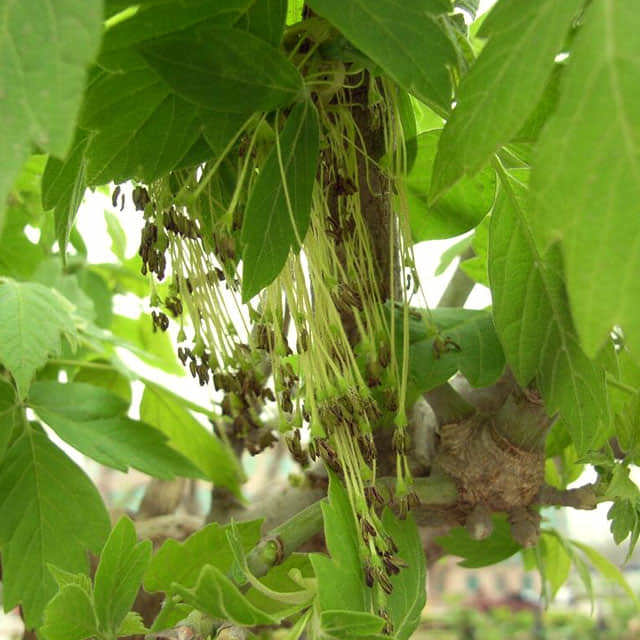
Why does your Acer negundo have fine webbing? Diagnose the cause and fix it with our step-by-step guide.
These tiny arachnids feed on the underside of Boxelder leaves, injecting toxins that cause stippling and produce fine silk webbing to protect their colonies. High temperatures and low humidity levels significantly accelerate their reproduction in Acer species.
Often found on deciduous trees like Acer negendo, these mites create a more subtle webbing that can lead to bronzing of the foliage. They thrive in similar environmental conditions as the two-spotted mite but are specifically adapted to woody perennials.
While primarily known for larger, dense silk nests in late summer, early instar larvae can produce finer silk strands as they move across the Boxelder canopy. These caterpillars consume the leaf tissue within the silk structures.
Your plant might also be experiencing one of these issues:

 English
 Italiano