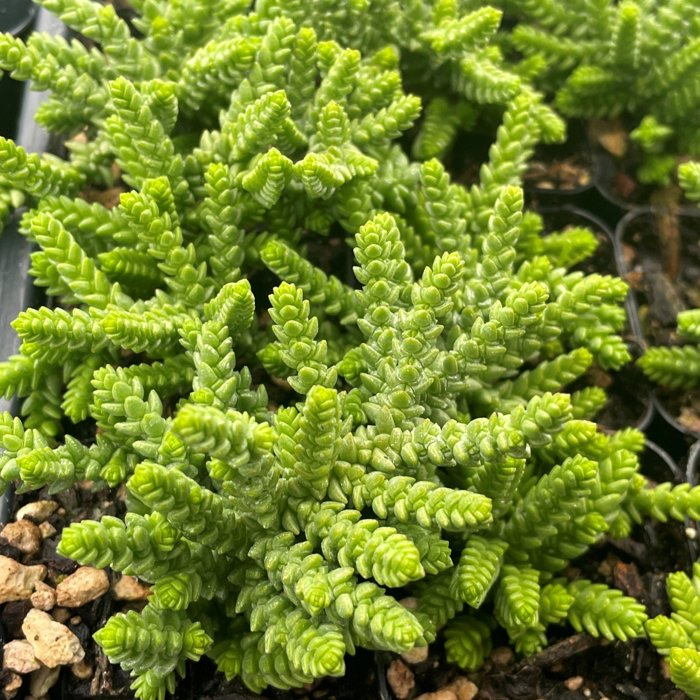
Crassula lycopodioides White Cottony Spots
eco White Cottony Spots

Crassula lycopodioides – White Cottony Spots

Why does your Crassula lycopodioides have white cottony spots? Diagnose the cause and fix it with our step-by-step guide.

search Possible Causes

error

Mealybugs

This is the most common cause of white, cottony masses on succulents like Crassula. These insects secrete a waxy, white substance to protect themselves while they suck sap from the plant's stem and leaf nodes.

Very Common
lightbulb
How to confirm: Use a cotton swab dipped in rubbing alcohol to dab the white spots; if the residue dissolves and turns brown, it is likely mealybugs.
build How to fix it
shopping_cart Recommended Products
1 Isolate the plant immediately to prevent the mealybugs from spreading to other succulents and treat the visible white masses with an organic insecticide spray.
2 Use a cotton swab dipped in isopropyl alcohol to manually remove individual mealybug clusters from the leaf nodes and stems.
3 Monitor the soil moisture levels to ensure the plant is not overly damp, as high humidity can encourage pest resurgence.
warning

Pseudococcidae (Cottony Cushion Scale)

Similar to mealybugs, these scale insects produce white, fluffy secretions that can resemble cotton. They often settle in the crevices of the 'Little Prince's' compact, upright stems.

Common
lightbulb
How to confirm: Check for small, hard bumps underneath the white fluff on the stem surfaces.
build How to fix it
shopping_cart Recommended Products
1 Isolate the plant immediately to prevent the scale insects from spreading to other houseplants.
2 Carefully wipe the white cottony spots off the stems using a cotton swab dipped in isopropyl alcohol to kill the insects on contact.
3 Apply an organic insecticide spray to the plant to eliminate any remaining pests and larvae.
warning

Sclerotinia or White Mold (Fungal)

Excessive moisture in the substrate can lead to fungal growth that appears as white, fuzzy patches. In Crassula lycopodioides, this usually manifests near the soil line or on decaying leaf bases.

Common
lightbulb
How to confirm: Inspect the base of the plant for any signs of mushy, darkened tissue accompanying the white fuzz.
build How to fix it
shopping_cart Recommended Products
1 Remove any heavily affected or decaying leaves and stems immediately to prevent the fungus from spreading to healthy tissue.
2 Reduce watering frequency and ensure the substrate is completely dry before next application; use a moisture meter to monitor the soil depth.
3 Apply an organic fungicide to protect the plant and treat existing fungal patches.
local_hospital All symptoms eco All plants with white cottony spots
favorite
