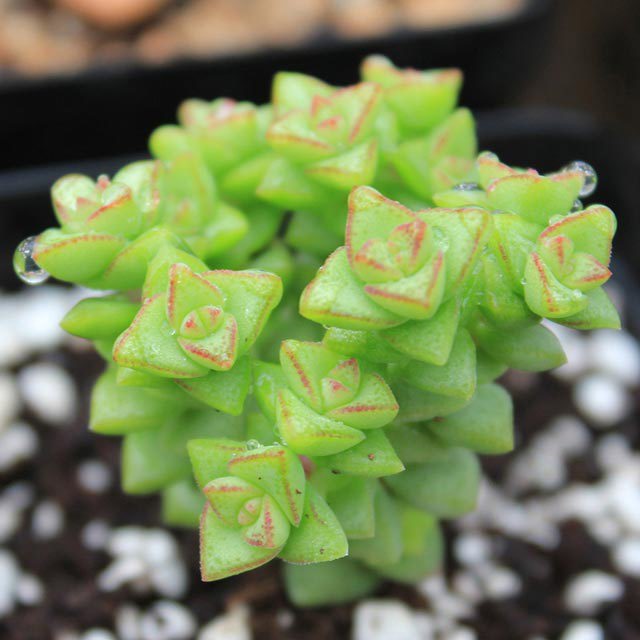
Why does your Crassula rupestris Tom Thumb have white cottony spots? Diagnose the cause and fix it with our step-by-step guide.
These small insects secrete a waxy, white substance to protect themselves, which appears as cottony tufts in the crevices of the Crassula's tight leaf clusters. They suck the sap from the plant, causing the succulent leaves to shrivel and eventually drop.
Scale insects can form white, felt-like coverings on the stems and leaves of Crassula rupestris. They embed themselves into the plant tissue to feed on nutrients, often leaving behind a sticky residue called honeydew.
In high humidity or poor airflow, Botrytis can manifest as fuzzy patches on succulent tissues. While usually more grayish, early stages can appear as white, cottony decay on the leaf edges.

 English
 Italiano