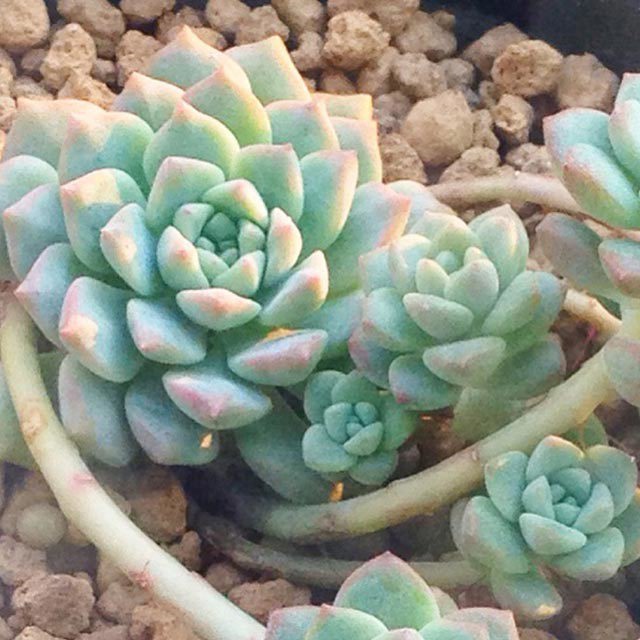
Why does your Echeveria prolifica have white powder? Diagnose the cause and fix it with our step-by-step guide.
A fungal disease that thrives in high humidity and poor air circulation around the tight rosette of Echeveria prolifica. It appears as a white, flour-like coating on the leaf surfaces.
These sap-sucking insects secrete a white, waxy, cottony substance to protect themselves. They often hide in the crevices between the fleshy leaves of the prolifica rosette.
Evaporated water droplets containing calcium or magnesium can leave white, crusty residue on the succulent's leaves. This is not a biological pathogen but an accumulation of salts.
In high humidity, Botrytis can manifest as a fuzzy white growth on decaying tissue. In Echeveria prolifica, this usually starts at the base of the rosette if moisture is trapped.
Your plant might also be experiencing one of these issues:

 English
 Italiano