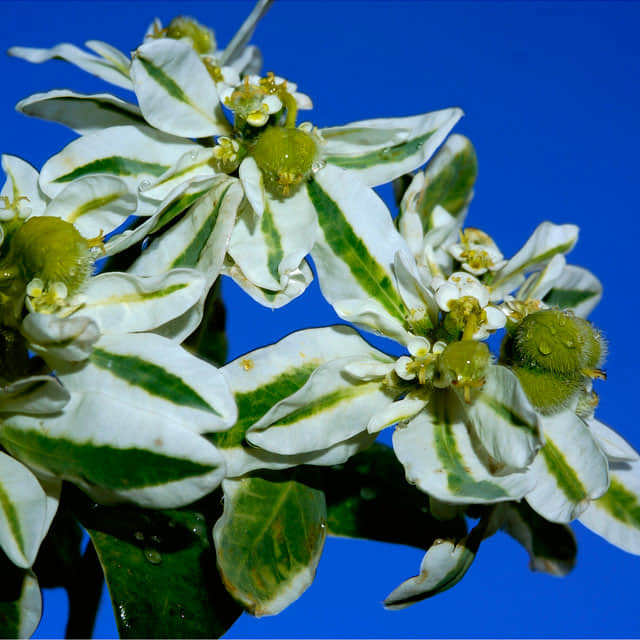
Euphorbia marginata Sticky Leaves
eco Sticky Leaves

Euphorbia marginata – Sticky Leaves

Why does your Euphorbia marginata have sticky leaves? Diagnose the cause and fix it with our step-by-step guide.

search Possible Causes

error

Aphid Infestation

Aphids are small, soft-bodied insects that pierce the stems and leaves of Euphorbia marginata to suck sap, excreting a sugary substance known as honeydew. This residue is the primary cause of sticky surfaces on the plant's foliage.

Very Common
lightbulb
How to confirm: Inspect the undersides of the variegated leaves and new growth for tiny, pear-shaped insects.
build How to fix it
shopping_cart Recommended Products
1 Apply an organic insecticide to eliminate the aphid population and stop the production of honeydew.
2 Wipe the leaves with a damp cloth to remove the sticky residue and prevent the growth of sooty mold.
3 Inspect the undersides of leaves and new growth for any remaining pests to prevent re-infestation.
warning

Scale Insects

Scale insects attach themselves to the stems or leaf undersides of the Euphorbia and feed on nutrients, leaving behind a sticky honeydew trail. Over time, this can lead to sooty mold growth on the white variegated margins.

Common
lightbulb
How to confirm: Look for small, stationary bumps or hard shells attached to the stems that do not move when prodded.
build How to fix it
shopping_cart Recommended Products
1 Treat the plant with an organic insecticide to eliminate the scale insects and stop the production of honeydew.
2 Gently wipe the leaves and stems with a soft cloth to remove the sticky residue and any secondary sooty mold growth.
3 Inspect the undersides of leaves and stems regularly to catch any remaining insects before they spread.
warning

Mealybugs

Mealybugs are related to scale and produce honeydew as they feed on the succulent tissues of the plant. They are often accompanied by a white, cottony substance in the leaf axils.

Common
lightbulb
How to confirm: Check the junctions where leaves meet the stem for white, fuzzy clusters.
build How to fix it
shopping_cart Recommended Products
1 Inspect the leaf axils for white, cottony clusters and treat the infestation immediately with an organic insecticide spray.
2 Wipe away the sticky honeydew and visible pests from the leaves using a cotton swab dipped in isopropyl alcohol.
3 Isolate the plant from other greenery to prevent the mealybugs from spreading to your other houseplants.
info

Excessive Nectar/Sap Leakage

If the plant has suffered physical damage or pruning, the caustic milky latex characteristic of Euphorbia species may leak and dry into a sticky residue. This is a physiological response rather than a pest issue.

Rare
lightbulb
How to confirm: Check for any recent mechanical damage, cuts, or broken stems on the plant.
build How to fix it
shopping_cart Recommended Products
1 Gently wipe the sticky residue from the leaves and stems using a soft cloth dampened with lukewarm water to prevent the caustic sap from hardening or attracting pests.
2 Avoid pruning or breaking stems of the Euphorbia, as this triggers the release of the milky, irritating latex.
3 Inspect the plant for any secondary pests like scale or aphids that might be attracted to the residue, and use an organic spray if needed.
local_hospital All symptoms eco All plants with sticky leaves
favorite
