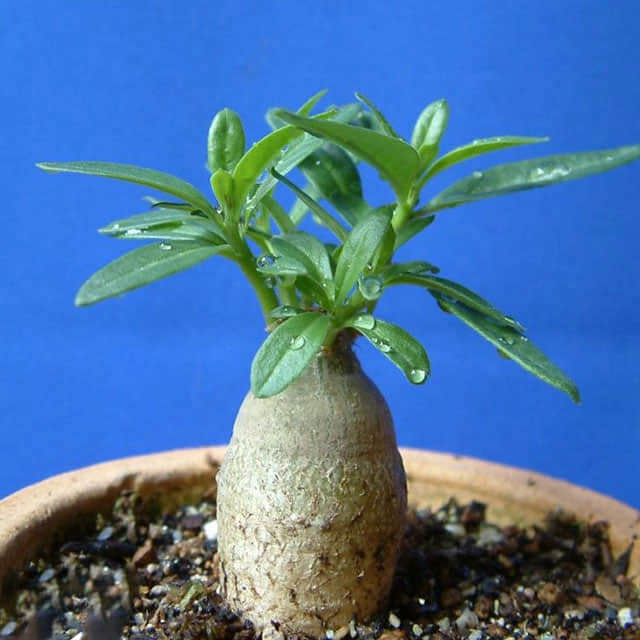
Pachypodium succulentum White Cottony Spots
eco White Cottony Spots

Pachypodium succulentum – White Cottony Spots

Why does your Pachypodium succulentum have white cottony spots? Diagnose the cause and fix it with our step-by-step guide.

search Possible Causes

error

Mealybugs

These small, soft-bodied insects produce a white, waxy, cottony secretion to protect themselves. They feed on the sap of the Pachypodium succulentum, often clustering in the leaf axils or crevices of the succulent stem.

Very Common
lightbulb
How to confirm: Use a cotton swab dipped in rubbing alcohol to wipe the spots; if they dissolve and reveal tiny insects underneath, it is mealybug infestation.
build How to fix it
shopping_cart Recommended Products
1 Isolate the plant immediately to prevent the mealybugs from spreading to your other houseplants.
2 Use a cotton swab dipped in isopropyl alcohol to manually remove the white cottony clusters from the stem crevices and leaf axils.
3 Apply an organic insecticide spray to the entire plant to eliminate any remaining insects and larvae.
warning

Cottony Scale

Similar to mealybugs, scale insects can appear as white, fuzzy masses on the stem or leaves of the Madagascar Palm. They attach themselves firmly to the plant tissue to suck out nutrients.

Common
lightbulb
How to confirm: Check if the white spots are stationary and feel somewhat hard or shell-like beneath the fuzz when poked with a needle.
build How to fix it
shopping_cart Recommended Products
1 Treat the affected areas with an organic insecticide spray to eliminate the scale insects and their eggs.
2 Manually remove visible white cottony masses using a cotton swab dipped in isopropyl alcohol to prevent further spread.
3 Isolate the plant from other greenery to prevent the scale insects from migrating to healthy plants.
warning

Sclerotinia (White Mold)

In conditions of high humidity and poor airflow, certain fungal pathogens can produce white, mycelium-like growth on the surface of the plant. This is less common in succulents but can occur if the base of the Pachypodium is too damp.

Common
lightbulb
How to confirm: Inspect the area for any signs of soft, rotting tissue or a musty odor accompanying the white fuzz.
build How to fix it
shopping_cart Recommended Products
1 Remove any heavily infected tissue and increase airflow around the plant to reduce humidity levels.
2 Apply an organic fungicide to the affected areas to control the fungal growth.
3 Repot the plant in a well-draining substrate and ensure the base remains dry to prevent further moisture-related rot.

Other Pachypodium succulentum problems

Your plant might also be experiencing one of these issues:

local_hospital All symptoms eco All plants with white cottony spots
favorite