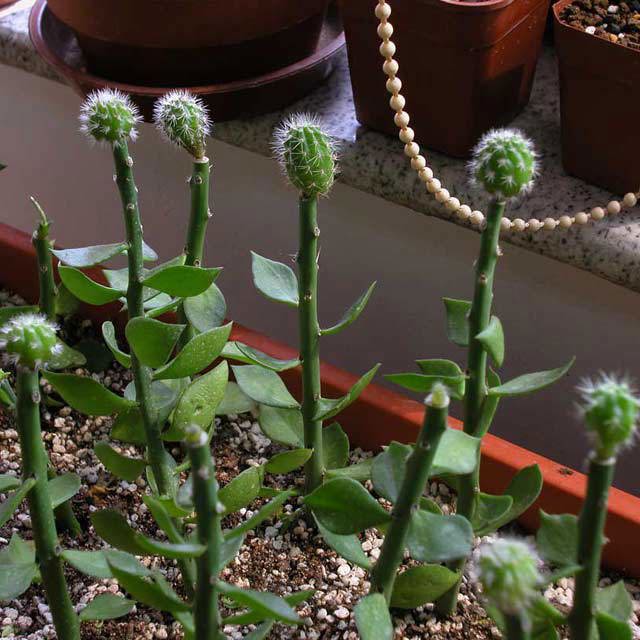
Why does your Pereskia spathulata have drooping leaves? Diagnose the cause and fix it with our step-by-step guide.
As a semi-succulent, Pereskia spathulata is highly susceptible to fungal pathogens like Phytophthora when soil remains saturated. Excessive moisture causes root decay, which prevents the plant from transporting water to the leaves, leading to sudden wilting.
While more drought-tolerant than true cacti, Pereskia spathulata has thin, deciduous leaves that lose turgor pressure rapidly when soil moisture is depleted. Severe dehydration causes the leaves to lose rigidity and hang limp.
Pereskia spathulata is sensitive to frost and sudden drops in temperature. Cold stress disrupts cellular functions and metabolic processes, often manifesting as drooping or even leaf drop.
A lack of available nitrogen prevents the production of chlorophyll and structural proteins necessary for leaf rigidity. In long-term indoor cultivation, depleted soil can lead to chlorosis followed by drooping.
Your plant might also be experiencing one of these issues:

 English
 Italiano