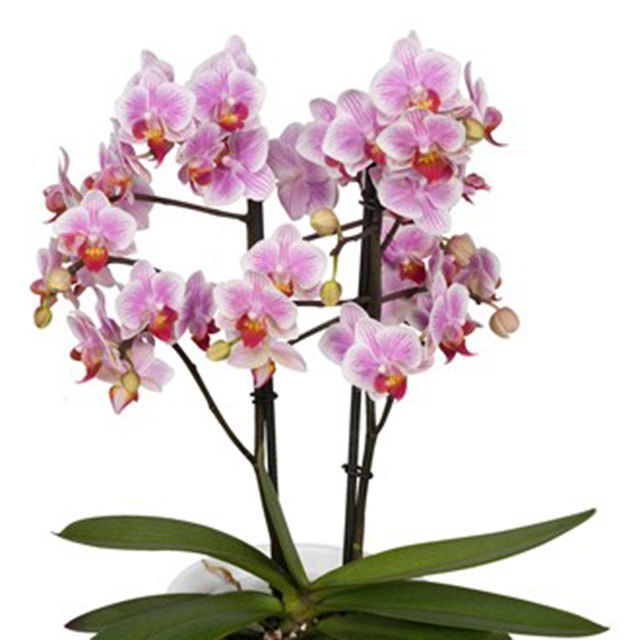
Why does your Phalaenopsis Belem have white powder? Diagnose the cause and fix it with our step-by-step guide.
A fungal disease caused by Oidium species that thrives in high humidity and poor air circulation around the Phalaenopsis leaves. The white spores form a visible coating on the leaf surface, which can eventually lead to necrotic lesions.
Small, white, cottony insects that congregate in the crevices of the Phalaenopsis leaves and flower spikes. They secrete a waxy substance that mimics a powdery or fuzzy appearance to protect themselves from predators.
Excessive accumulation of fertilizers or hard water minerals on the leaf surface following evaporation. This can leave a crusty, white, powdery residue that is not biological in nature.
While typically appearing as brown spots, early colonization by Botrytis cinerea can sometimes present as a fuzzy, whitish mycelium on decaying tissue or flower buds.
Your plant might also be experiencing one of these issues:

 English
 Italiano

