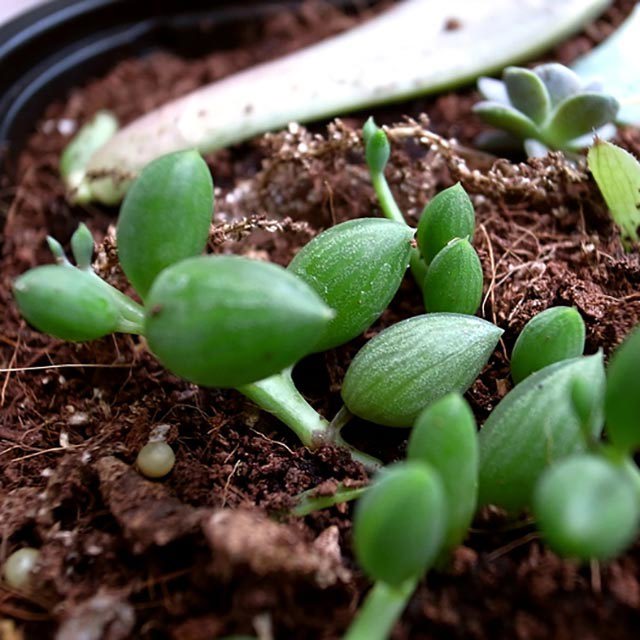
Senecio herreianus Sudden Leaf Drop
eco Sudden Leaf Drop

Senecio herreianus – Sudden Leaf Drop

Why does your Senecio herreianus have sudden leaf drop? Diagnose the cause and fix it with our step-by-step guide.

search Possible Causes

error

Overwatering and Root Rot

As a succulent, Senecio herreianus is highly susceptible to fungal pathogens like Phytophthora when soil remains saturated. Excessive moisture causes root decay, which prevents water transport to the leaves, leading to rapid leaf abscission.

Very Common
lightbulb
How to confirm: Gently lift the plant from its pot to check if the roots are dark, mushy, or emitting a foul odor.
build How to fix it
shopping_cart Recommended Products
1 Immediately remove the plant from its current pot and inspect the roots; trim away any mushy, black, or foul-smelling roots using sterilized tools.
2 Repot the plant in a well-draining, gritty substrate specifically designed for succulents to prevent future water retention.
3 Use a moisture meter to monitor the soil and ensure you only water when the substrate is completely dry to the touch.
error

Temperature Shock/Cold Stress

This species is sensitive to sudden drops in ambient temperature. Exposure to drafts or temperatures below 50°F (10°C) can trigger a stress response, causing the plant to shed leaves to conserve moisture.

Very Common
lightbulb
How to confirm: Check if the plant has been recently moved near a window, door, or air conditioning vent.
build How to fix it
shopping_cart Recommended Products
1 Immediately move the plant to a warm, draft-free location, ensuring temperatures remain consistently above 50°F (10°C).
2 Monitor soil moisture closely to ensure the plant is not overwatered while in a stressed state, as cold temperatures slow down evaporation.
3 Avoid applying fertilizer until the plant shows new growth and has stabilized in the new environment.
warning

Pest Infestation (Mealybugs or Scale)

Sucking insects feed on the sap of the succulent stems, weakening the plant's structural integrity. Severe infestations can cause leaves to lose turgidity and drop unexpectedly.

Common
lightbulb
How to confirm: Inspect the crevices where the leaves meet the stem for small white cottony patches or hard brown bumps.
build How to fix it
shopping_cart Recommended Products
1 Inspect the stems and leaf axils for white, cottony masses (mealybugs) or hard, brown bumps (scale) and treat immediately with an organic insecticide spray.
2 Isolate the plant from other greenery to prevent the infestation from spreading to your other succulents.
3 Gently wipe away visible pests with a cotton swab dipped in isopropyl alcohol to reduce the population before spraying.
warning

Nutrient Deficiency (Nitrogen)

A lack of essential macronutrients, particularly nitrogen, can lead to chlorosis and eventual leaf drop as the plant attempts to reallocate resources to its core stem.

Common
lightbulb
How to confirm: Observe if the older, lower leaves are turning yellow before dropping compared to the newer growth.
build How to fix it
shopping_cart Recommended Products
1 Apply a nitrogen-rich liquid fertilizer to boost vegetative growth and prevent further leaf loss.
2 Monitor soil moisture levels using a moisture meter to ensure the plant is not also suffering from overwatering, which can mimic nitrogen deficiency symptoms.
3 Ensure the plant is receiving adequate bright, indirect light to support nutrient uptake and photosynthesis.

Other Senecio herreianus problems

Your plant might also be experiencing one of these issues:

local_hospital All symptoms eco All plants with sudden leaf drop
favorite