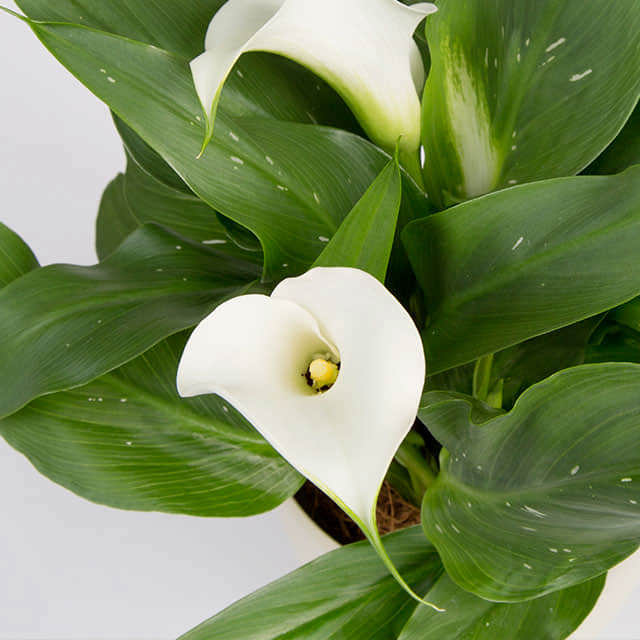
Why does your Zantedeschia aethiopica have white powder? Diagnose the cause and fix it with our step-by-step guide.
A fungal disease caused by Oomycetes or Ascomycetes that thrives in high humidity and poor air circulation around the large Calla Lily leaves. It presents as a distinct white, flour-like coating on the leaf surfaces.
Small, soft-bodied insects that secrete a white, waxy, cottony substance to protect themselves. They tend to cluster in the leaf axils and under the large spathes of the Zantedeschia.
Calcium or magnesium carbonates from tap water can dry on the surface of the large, smooth leaves after misting or heavy watering. This creates a crusty, white, inorganic residue rather than a biological growth.
While typically causing rot, the early stages of Botrytis can appear as light-colored, grayish-white fuzzy patches on the petal-like spathe or leaf margins in damp conditions.
Your plant might also be experiencing one of these issues:

 English
 Italiano