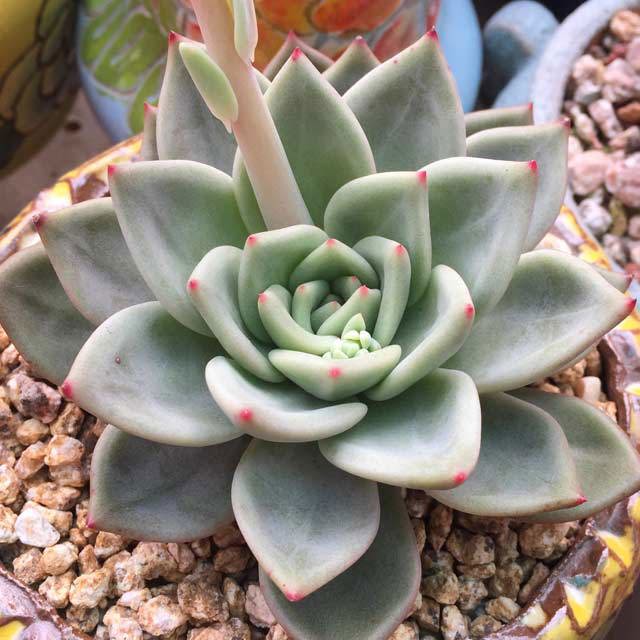
Echeveria Baekya White Cottony Spots
eco White Cottony Spots

Echeveria Baekya – White Cottony Spots

Why does your Echeveria Baekya have white cottony spots? Diagnose the cause and fix it with our step-by-step guide.

search Possible Causes

error

Mealybugs

Mealybugs are common pests for succulents like Echeveria Baekya that secrete a white, waxy, cotton-like substance to protect themselves. They feed on the plant's sap, which can lead to leaf yellowing and stunted growth of the rosette.

Very Common
lightbulb
How to confirm: Use a magnifying glass to check the crevices between the leaves and near the base of the plant for tiny moving insects.
build How to fix it
shopping_cart Recommended Products
1 Isolate the plant immediately to prevent the spread of mealybugs to other succulents and wipe off visible white cottony spots using a cotton swab dipped in isopropyl alcohol.
2 Apply an organic insecticide spray to the entire plant, ensuring you reach the crevices of the rosette, to eliminate remaining insects and larvae.
3 Monitor the soil moisture levels to ensure the plant is not overwatered, as damp environments can encourage pest resurgence.
warning

Powdery Mildew

This fungal disease manifests as a white, flour-like coating on the leaf surfaces, often triggered by high humidity and poor airflow around the Echeveria leaves. Unlike pests, this fungus stays on the surface of the leaf epidermis.

Common
lightbulb
How to confirm: Rub the white spot with your finger; if it wipes off easily without leaving a residue or moving insects behind, it may be fungal.
build How to fix it
shopping_cart Recommended Products
1 Apply an organic fungicide to the affected leaves to eliminate the powdery mildew spores and prevent further spread.
2 Improve air circulation around the plant and reduce humidity by avoiding overhead watering, which keeps the leaf surfaces dry.
3 Gently wipe the white spots off the leaves with a soft cloth or soft brush to remove visible fungal buildup.
warning

Cottony Blight (Botrytis)

While less common in arid-loving Echeveria, high moisture levels can lead to Botrytis, which appears as fuzzy, greyish-white growth on decaying plant tissue. This usually follows a period of excessive watering or leaf rot.

Common
lightbulb
How to confirm: Inspect the base of the leaves for soft, mushy, or translucent spots accompanied by the white fuzz.
build How to fix it
shopping_cart Recommended Products
1 Immediately remove and discard any leaves showing fuzzy, greyish-white growth to prevent the fungus from spreading to healthy tissue.
2 Reduce watering frequency and ensure the plant is in a well-draining medium; consider adding perlite to improve aeration and prevent moisture retention.
3 Apply an organic fungicide to protect the remaining healthy leaves from further infection.

Other Echeveria Baekya problems

Your plant might also be experiencing one of these issues:

local_hospital All symptoms eco All plants with white cottony spots
favorite


