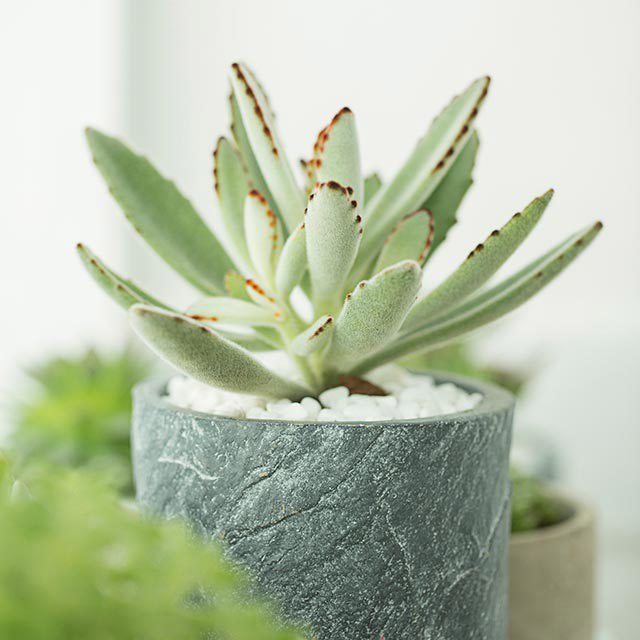
Kalanchoe tomentosa Drooping Leaves
eco Drooping Leaves

Kalanchoe tomentosa – Drooping Leaves

Why does your Kalanchoe tomentosa have drooping leaves? Diagnose the cause and fix it with our step-by-step guide.

search Possible Causes

error

Underwatering and Dehydration

As a succulent, Kalanchoe tomentosa stores water in its fleshy leaves; when soil moisture is depleted, the plant loses turgor pressure, causing the fuzzy leaves to wilt and droop.

Very Common
lightbulb
How to confirm: Check if the soil is bone-dry several inches below the surface and if the leaves feel thin or wrinkled.
build How to fix it
shopping_cart Recommended Products
1 Immediately check the soil moisture level using a probe to confirm the depth of dehydration.
2 Thoroughly soak the soil with water until it drains from the bottom of the pot, ensuring the root ball is fully rehydrated.
3 Ensure the plant is in a pot with excellent drainage and consider adding perlite to the soil to prevent future water retention issues.
error

Root Rot due to Overwatering

Excessive moisture in the substrate prevents oxygen from reaching the roots, leading to fungal decay which destroys the plant's ability to transport water to the leaves.

Very Common
lightbulb
How to confirm: Gently lift the plant from its pot to see if the roots are dark, slimy, or emit a foul odor.
build How to fix it
shopping_cart Recommended Products
1 Immediately remove the plant from its current pot and inspect the roots for any mushy, black, or foul-smelling decay; prune away all damaged roots using sterilized tools.
2 Repot the Kalanchoe in a fresh, well-draining substrate specifically designed for succulents, such as a mix containing perlite or pumice to ensure proper aeration.
3 Transition to a more breathable container and use a moisture meter to ensure the soil is completely dry before watering again to prevent future rot.
warning

Temperature Stress (Cold Shock)

Kalanchoe tomentosa is sensitive to low temperatures; exposure to drafts or temperatures below 50°F (10°C) can cause metabolic slowdown and leaf drooping.

Common
lightbulb
How to confirm: Check if the plant is located near a cold window, air conditioning vent, or in an unheated area.
build How to fix it
shopping_cart Recommended Products
1 Immediately move your Kalanchoe to a warmer, draft-free location within your home, ensuring temperatures remain consistently above 50°F (10°C).
2 Monitor the soil moisture closely to ensure the plant is not also suffering from overwatering, as cold stress can slow down water uptake.
3 If the plant shows signs of recovery, you can apply a light feeding of liquid seaweed to help boost metabolic resilience and stress recovery.
warning

Nutrient Deficiency (Nitrogen)

A lack of essential macronutrients can weaken the structural integrity of the leaves, leading to a loss of upright posture over time.

Common
lightbulb
How to confirm: Observe if the drooping is accompanied by a distinct yellowing of the older, lower leaves.
build How to fix it
shopping_cart Recommended Products
1 Apply a nitrogen-rich liquid fertilizer to boost vegetative growth and restore leaf structural integrity.
2 Check the soil moisture levels with a meter to ensure the drooping isn't actually caused by underwatering.
3 Ensure the plant is receiving adequate bright, indirect light to support nutrient uptake and photosynthesis.

Other Kalanchoe tomentosa problems

Your plant might also be experiencing one of these issues:

local_hospital All symptoms eco All plants with drooping leaves
favorite