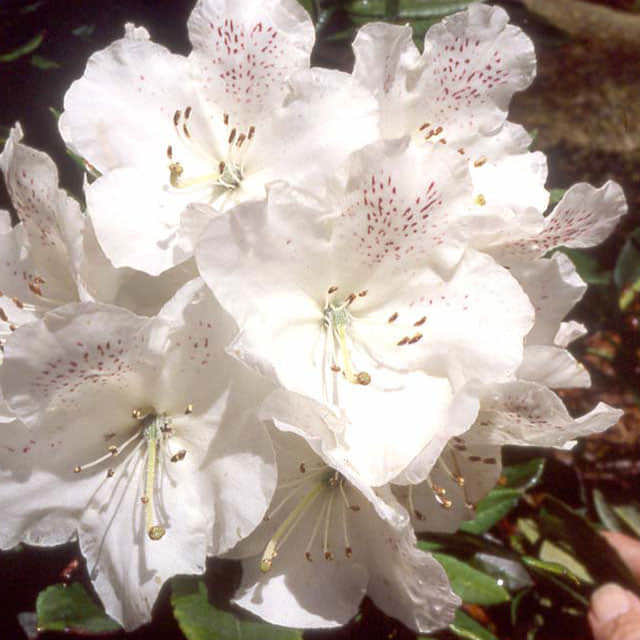
Rhododendron Aberconwayi White Cottony Spots
eco White Cottony Spots

Rhododendron Aberconwayi – White Cottony Spots

Why does your Rhododendron Aberconwayi have white cottony spots? Diagnose the cause and fix it with our step-by-step guide.

search Possible Causes

error

Mealybugs

These sap-sucking insects secrete a white, waxy, cottony substance to protect themselves while feeding on the tender new growth of Rhododendron. They often congregate in leaf axils and can lead to leaf yellowing and stunted development.

Very Common
lightbulb
How to confirm: Gently wipe the spots with a cotton swab soaked in isopropyl alcohol to see if a small insect is revealed underneath.
build How to fix it
shopping_cart Recommended Products
1 Isolate the plant immediately to prevent the mealybugs from spreading to your other houseplants.
2 Apply an organic insecticide spray to the affected areas to kill the insects and remove the protective waxy coating.
3 Gently wipe away visible cottony clusters using a cotton swab dipped in isopropyl alcohol to disrupt the infestation.
error

Woolly Aphids

Similar to mealybugs, woolly aphids produce a white, fluffy secretion that covers parts of the stems and leaves. They thrive in the humid environments often preferred by Aberconway's Rhododendron.

Very Common
lightbulb
How to confirm: Check if the cottony mass is concentrated along the stems and look for sticky honeydew residue on the leaf surfaces below.
build How to fix it
shopping_cart Recommended Products
1 Apply an organic insecticide spray to eliminate the woolly aphids and their white secretions.
2 Carefully wipe the affected stems and leaves with a cotton swab dipped in isopropyl alcohol to remove visible aphid colonies.
3 Monitor the plant's humidity levels, as high moisture can encourage aphid populations; ensure good airflow around the foliage.
warning

Scale Insects (Cottony Scale)

Certain species of scale produce a white, flocculent covering that resembles cotton. While they don't move as much as aphids, they can cause significant damage to the vascular system of the rhododendron.

Common
lightbulb
How to confirm: Inspect the underside of the leaves and the base of the petioles for hard, immobile bumps beneath the white fluff.
build How to fix it
shopping_cart Recommended Products
1 Apply an organic insecticide spray to the plant to eliminate the cottony scale insects and their eggs.
2 Manually remove visible white cottony clusters from stems and leaves using a soft brush or cloth to reduce the infestation.
3 Monitor the plant's health and ensure it is not under environmental stress, which can make it more susceptible to pests.
warning

Powdery Mildew (Early Stage/Fungal)

While typically appearing as a fine dust, certain fungal outbreaks can manifest as thicker, patchier white clusters on foliage in high-humidity conditions. This is common in Rhododendrons if air circulation is poor.

Common
lightbulb
How to confirm: Try to rub the white substance with your finger; if it wipes off easily like fine powder rather than being a structural mass, it is likely fungal.
build How to fix it
shopping_cart Recommended Products
1 Apply an organic fungicide to the affected foliage to eliminate the fungal spores and prevent the spread of the mildew.
2 Improve air circulation around the plant by pruning crowded branches and ensuring it is not placed in a stagnant, high-humidity corner.
3 Prune and dispose of any heavily infected leaves to reduce the fungal load on the rest of the plant.

Other Rhododendron Aberconwayi problems

Your plant might also be experiencing one of these issues:

local_hospital All symptoms eco All plants with white cottony spots
favorite



