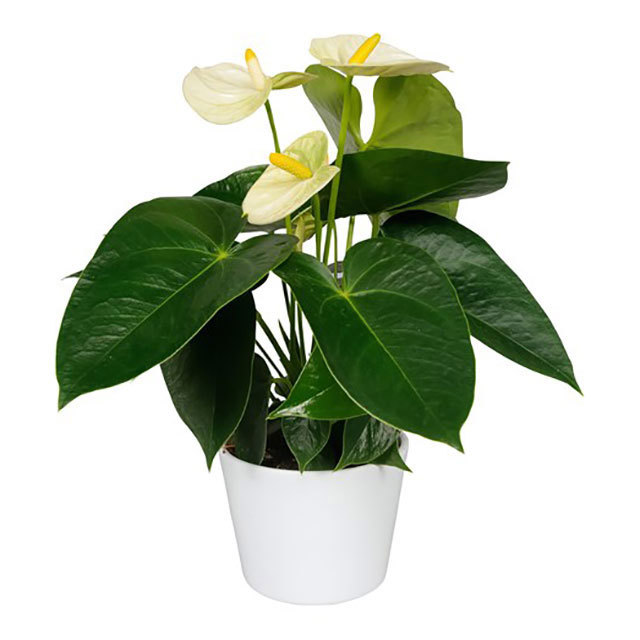
Why does your Anthurium andraeanum Bianco have yellow leaves? Diagnose the cause and fix it with our step-by-step guide.
Anthuriums are highly sensitive to moisture levels; constant wet soil leads to oxygen deprivation in the roots, causing yellowing of older leaves. This is the most common cause of chlorosis in Anthurium andraeanum.
A lack of essential macronutrients prevents the plant from producing sufficient chlorophyll, leading to uniform yellowing across leaf surfaces. In Anthuriums, this often presents as pale new growth or yellowing of older foliage.
Too much direct sunlight can cause leaf bleaching and yellowing (sunscald), while too little light reduces the plant's ability to photosynthesize efficiently. White Anthuriums prefer bright, indirect light.
Anthuriums are tropical plants that thrive in stable warmth; exposure to drafts or temperatures below 60°F (15°C) can trigger physiological stress and yellowing. Sudden drops in temperature often cause the plant to drop leaves.
Your plant might also be experiencing one of these issues:

 English
 Italiano